Architecture
Chakshu is one Python codebase. On your server it runs as two processes, web and worker, next to Postgres. Each review runs somewhere else: on a GitHub Actions runner in the repository being reviewed, so the server stays small and the logs sit in that repository's Actions tab.
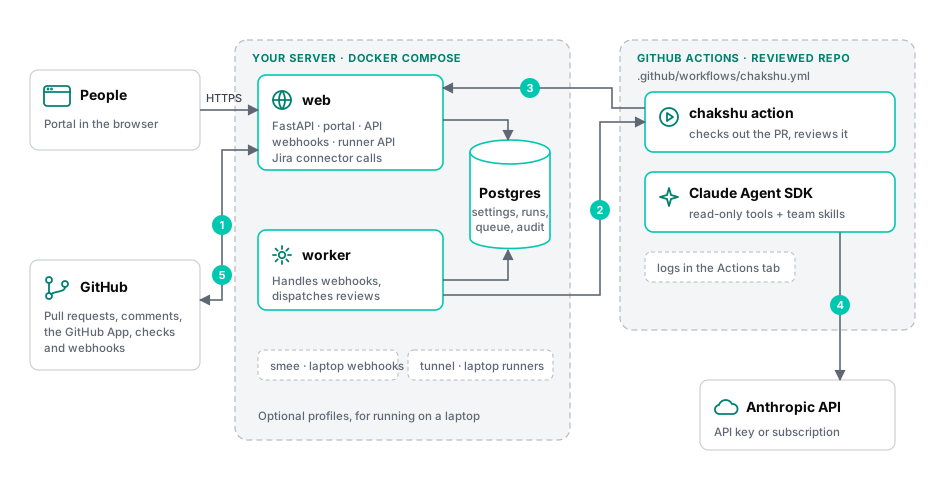
- Ask. Someone mentions
@org/chakshuor requests it as a reviewer, and GitHub sends a webhook toweb. The portal's Review button skips this step. - Dispatch. The
workerpicks the reviewers and starts.github/workflows/chakshu.ymlin that repository withworkflow_dispatch. - Fetch the job. The runner proves which run it is with its OIDC token and gets the prompt, the reviewer's skills and its connector tools from
web. - Review. Claude reads the pull request with read-only tools. Connector calls such as Jira go back to
web, so their credentials never leave the server. - Post. The runner sends the findings to
web, which posts the review and the check run as the GitHub App.
There's no Redis and no message broker. Postgres holds settings, a cache of each organization's reviewers, and the runs table, which is also the job queue.
Stack
-
API
Python 3.12, FastAPI, Pydantic Settings, signed-cookie sessions
-
Data
PostgreSQL 17, SQLAlchemy 2 (async, asyncpg), Alembic
-
Portal
React 19, TypeScript, Vite, Tailwind v4, shadcn/ui, TanStack Query
-
GitHub
githubkit for the app, installation, OAuth and user clients, and webhook checks
-
Reviews
Claude Agent SDK on GitHub Actions runners
-
Secrets
Fernet, with a key derived by HKDF from
CHAKSHU_SECRET_KEY
How the code is layered
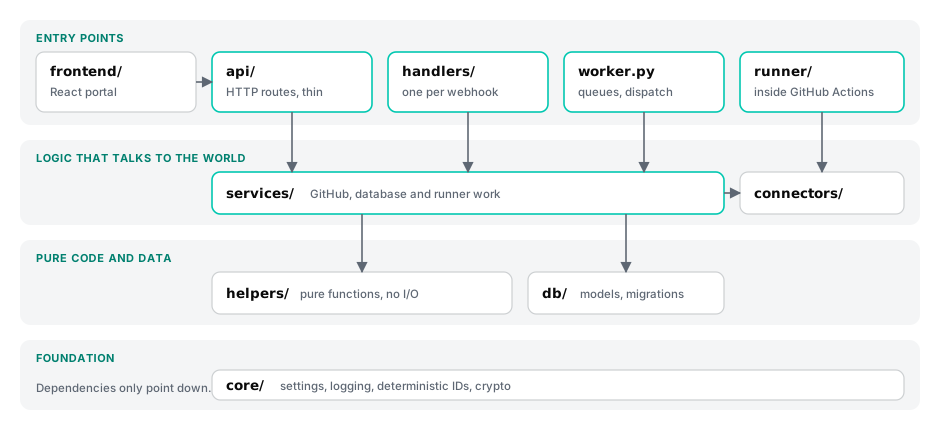
Routes stay thin: they check input, call a service and return JSON. Anything that touches GitHub, the database or a runner lives in services/. Anything that can be a pure function lives in helpers/, where it's easy to test.
Code layout
src/chakshu/ holds the server and the runner. frontend/src/ holds the portal.
| Folder | What lives there | Examples |
|---|---|---|
api/ |
HTTP routes for the portal, webhooks and runners | runner.py, analytics.py, repos.py |
handlers/ |
One module per GitHub webhook event | issue_comment.py, workflow_run.py |
worker.py |
The worker loop: webhook queue, dispatch, maintenance | |
services/ |
Work that talks to GitHub, the database or a runner | dispatcher.py, jobs.py, review_results.py, repo_setup.py, analytics.py |
runner/ |
What runs inside GitHub Actions | protocol.py, client.py, engine.py |
connectors/ |
Connector kinds and the bridge that forwards tool calls | jira.py, bridge.py |
helpers/ |
Pure functions with no I/O | selection.py, prompt.py, findings.py, workspace.py |
db/ |
Models, sessions and migrations | models.py, migrations/ |
core/ |
Settings, logging, deterministic IDs, crypto | config.py, ids.py |
templates/ |
The workflow file Chakshu proposes to repositories | chakshu.yml |
frontend/src/pages/ |
One file per portal screen | analytics-page.tsx, repo-page.tsx |
frontend/src/components/ |
Shared pieces and shadcn/ui components | analytics-charts.tsx, ui/ |
frontend/src/lib/ |
API client and formatting | api.ts, format.ts |
Data
| Table | Holds |
|---|---|
settings |
Portal settings; secrets encrypted |
installations |
GitHub App installations |
users |
People who sign in |
repos |
Repositories the app can see, and whether reviews are on |
reviewers |
Cache of each reviewer.yaml, the commit it came from and any errors |
runs |
One reviewer, one pull request, one commit (or one reply), with its Actions run; also the job queue |
posted_findings |
Findings Chakshu posted and what became of them |
connectors |
Outside systems reviewers can read; credentials encrypted |
webhook_events |
Webhooks waiting for or handled by the worker, keyed by delivery ID so redeliveries are dropped |
analytics_audit |
Who viewed or exported analytics about named people |
Every primary key is a deterministic ID.